


Hotline:
+1 (678) 244-1536
sales@hpc-standards.us
271 17th Street, NW, Suite 1750
Atlanta, GA 30363

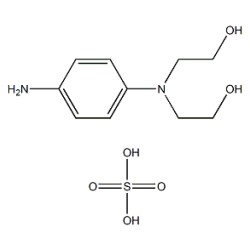
N,N-Bis(2-hydroxyethyl)-p-phenylenediamine sulphate
ISO 17034 Reference Material
| Item number | 689758 |
| CAS | 54381-16-7 |
| Formula | C10H18N2O6S |
| Molecular weight | 294,33 g/mol |
| Quantity | 1x100mg |
| storage conditions | 4 °C |
| CoA / MSDS | Retrieve CoA Retrieve MSDS Show Safety Data Sheet online |
Price |
| Safety Data Sheet | according to Regulation (EC) No 1907/2006 (REACH) Classifications according to Regulation (EC) No 1272/2008. Printdate October 8, 2026 |
| IDENTIFICATION OF THE SUBSTANCE/MIXTURE AND OF THE COMPANY/UNDERTAKING | |
| Product name: | N,N-Bis(2-hydroxyethyl)-p-phenylenediamine sulphate |
| Catalog No.: | 689758 |
| Relevant identified uses of the substance or mixture | Identified: Laboratory chemical uses: R&D |
| Uses advised against: | HPC Standards Inc 271 17th Street, NW, Suite 1750 Atlanta, GA 30363 Tel. +1 (678) 244-1536 Fax. +1 (404) 586-6820 sales@hpc-standards.us |
| Emergency telephone number | HPC Standards Tel. +1 (678) 244-1536 This number is only available during office hours. |
| HAZARDS IDENTIFICATION | · 2.1 Classification of the substance or mixture · Classification according to Regulation (EC) No 1272/2008 skull and crossbones Acute Tox. 3 H301 Toxic if swallowed. Acute Tox. 3 H311 Toxic in contact with skin. Acute Tox. 3 H331 Toxic if inhaled. environment Aquatic Acute 1 H400 Very toxic to aquatic life. Aquatic Chronic 1 H410 Very toxic to aquatic life with long lasting effects. 53.0.1 Eye Irrit. 2 H319 Causes serious eye irritation. Skin Sens. 1 H317 May cause an allergic skin reaction. |
| Label elements | |
| Pictogram | GHS06 skull skull GHS07 exclam exclam GHS09 Aquatic-pollut-red Aquatic-pollut-red |
| · 2.2 Label elements · Labelling according to Regulation (EC) No 1272/2008 The substance is classified and labelled according to the CLP regulation. · Hazard pictograms GHS06 GHS09 · Signal word Danger · Hazard statements H301+H311+H331 Toxic if swallowed, in contact with skin or if inhaled. H319 Causes serious eye irritation. H317 May cause an allergic skin reaction. H410 Very toxic to aquatic life with long lasting effects. · Precautionary statements P261 Avoid breathing dust/fume/gas/mist/vapours/spray. P301+P310 IF SWALLOWED: Immediately call a POISON CENTER/ doctor. P305+P351+P338 IF IN EYES: Rinse cautiously with water for several minutes. Remove contact lenses, if present and easy to do. Continue rinsing. P321 Specific treatment (see on this label). P405 Store locked up. P501 Dispose of contents/container in accordance with local/regional/national/international regulations. · 2.3 Other hazards · Results of PBT and vPvB assessment · PBT: Not applicable. · vPvB: Not applicable. | |
| COMPOSITION/INFORMATION ON INGREDIENTS | · 3.1 Substances · CAS No. Description 54381-16-7 N,N-Bis(2-hydroxyethyl)-1,4-phenylenediamine sulfate · Identification number(s) None · EC number: 259-134-5 · RTECS: KJ6610300 · Additional information: For the wording of the listed hazard phrases refer to section 16. |
| Formula | C10H18N2O6S |
| Molecular Weight (g/mol) | 294.33 |
| CAS-No. | 54381-16-7 |
| FIRST AID MEASURES | · 4.1 Description of first aid measures · General information: Immediately remove any clothing soiled by the product. Remove breathing equipment only after contaminated clothing has been completely removed. In case of irregular breathing or respiratory arrest provide artificial respiration. · After inhalation: Supply fresh air or oxygen; call for doctor. In case of unconsciousness place patient in recovery position for transport. Seek immediate medical advice. · After skin contact: Immediately wash with water and soap and rinse thoroughly. Seek immediate medical advice. · After eye contact: Rinse opened eye for several minutes under running water. If symptoms persist, consult a doctor. · After swallowing: Rinse mouth. Do not induce vomiting. Call for a doctor immediately. · 4.2 Most important symptoms and effects, both acute and delayed No further relevant information available. · 4.3 Indication of any immediate medical attention and special treatment needed No further relevant information available. |
| FIRE-FIGHTING MEASURES | · 5.1 Extinguishing media · Suitable extinguishing agents: Use fire extinguishing methods suitable for surrounding conditions. · 5.2 Special hazards arising from the substance or mixture Formation of toxic gases is possible during heating or in case of fire. · 5.3 Advice for firefighters · Protective equipment: Mouth respiratory protective device. Wear self-contained respiratory protective device. |
| ACCIDENTAL RELEASE MEASURES | · 6.1 Personal precautions, protective equipment and emergency procedures Avoid formation of dust. · 6.2 Environmental precautions: Inform respective authorities in case of seepage into water course or sewage system. Do not allow to enter sewers/ surface or ground water. · 6.3 Methods and material for containment and cleaning up: Dispose of contaminated material as waste according to item 13. Ensure adequate ventilation. · 6.4 Reference to other sections See Section 7 for information on safe handling. See Section 8 for information on personal protection equipment. See Section 13 for disposal information |
| HANDLING AND STORAGE | |
| EXPOSURE CONTROLS/PERSONAL PROTECTION | · 8.1 Control parameters · Ingredients with limit values that require monitoring at the workplace: Not required. · Additional information: Lists used were valid at the time of SDS preparation. · 8.2 Exposure controls · Appropriate engineering controls No further data; see item 7. · Individual protection measures, such as personal protective equipment · General protective and hygienic measures: Keep away from foodstuffs, beverages and feed. Immediately remove all soiled and contaminated clothing Wash hands before breaks and at the end of work. Store protective clothing separately. Avoid contact with the eyes. Avoid contact with the eyes and skin. · Respiratory protection: In case of brief exposure or low pollution use respiratory filter device. In case of intensive or longer exposure use self-contained respiratory protective device. Follow the OSHA respirator regulations found in 29 CFR 1910.134 or European Standard EN 149. Use a NIOSH/MSHA or European Standard EN 149 approved respirator if exposure limits are exceeded or if irritation or other symptoms are experienced · Hand protection The glove material has to be impermeable and resistant to the product/ the substance/ the preparation. Selection of the glove material on consideration of the penetration times, rates of diffusion and the degradation The protective gloves to be used must comply with the specifications of EC Directive 89/686/EEC and the related standard EN374 Protective gloves · Material of gloves Butyl rubber, BR · Penetration time of glove material The exact break through time has to be found out by the manufacturer of the protective gloves and has to be observed. · Eye/face protection Tightly sealed goggles |
| PHYSICAL AND CHEMICAL PROPERTIES | · 9.1 Information on basic physical and chemical properties · General Information · Physical state Solid · Colour: Off white · Odour: Odourless · Odour threshold: Not determined. · Melting point/freezing point: 125 °C · Boiling point or initial boiling point and boiling range Not determined. · Flammability Not determined. · Lower and upper explosion limit · Lower: Not determined. · Upper: Not determined. · Flash point: Not applicable. · Auto-ignition temperature: Not determined. · Decomposition temperature: Not determined. · pH Not applicable. · Viscosity: · Kinematic viscosity Not applicable. · Dynamic: Not applicable. · Solubility · water at 20 °C: 178 g/l · Partition coefficient n-octanol/water (log value) -2.8 LogP · Vapour pressure: Not applicable. · Density and/or relative density · Density at 20 °C: 1.497 g/cm³ · Relative density Not determined. · Vapour density Not applicable. · 9.2 Other information · Appearance: · Form: Powder · Important information on protection of health and environment, and on safety. · Ignition temperature: Not determined · Explosive properties: Not determined. · Change in condition · Evaporation rate Not applicable. · Information with regard to physical hazard classes · Explosives Not applicable · Flammable gases Not applicable · Aerosols Not applicable · Oxidising gases Not applicable · Gases under pressure Not applicable · Flammable liquids Not applicable · Flammable solids Not applicable · Self-reactive substances and mixtures Not applicable · Pyrophoric liquids Not applicable · Pyrophoric solids Not applicable · Self-heating substances and mixtures Not applicable · Substances and mixtures, which emit flammable gases in contact with water Not applicable · Oxidising liquids Not applicable · Oxidising solids Not applicable · Organic peroxides Not applicable · Corrosive to metals Not applicable · Desensitised explosives Not applicable |
| STABILITY AND REACTIVITY | · 10.1 Reactivity Stable under normal conditions. No further relevant information available. · 10.2 Chemical stability Stable under normal conditions. · Thermal decomposition / conditions to be avoided: Formation of toxic gases is possible during heating or in case of fire. · 10.3 Possibility of hazardous reactions No dangerous reactions known. · 10.4 Conditions to avoid Heat. · 10.5 Incompatible materials: Strong oxidizing agents · 10.6 Hazardous decomposition products: Formation of toxic gases is possible during heating or in case of fire. |
| TOXICOLOGICAL INFORMATION | · 11.1 Information on hazard classes as defined in Regulation (EC) No 1272/2008 · Acute toxicity Toxic if swallowed, in contact with skin or if inhaled. · LD/LC50 values relevant for classification: Oral LD50 246 mg/kg (rat) · Skin corrosion/irritation Based on available data, the classification criteria are not met. · Serious eye damage/irritation Causes serious eye irritation. · Respiratory or skin sensitisation May cause an allergic skin reaction. · 11.2 Information on other hazards · Endocrine disrupting properties Substance is not listed. |
| ECOLOGICAL INFORMATION | · 12.1 Toxicity · Aquatic toxicity: EC50/48 h 0.381 mg/l (daphnia) EC50/72h 0.338 mg/l (Algae) LC50/96 h >235 mg/l (fish) · 12.2 Persistence and degradability No further relevant information available. · 12.3 Bioaccumulative potential No further relevant information available. · 12.4 Mobility in soil No further relevant information available. · 12.5 Results of PBT and vPvB assessment · PBT: Not applicable. · vPvB: Not applicable. · 12.6 Endocrine disrupting properties The product does not contain substances with endocrine disrupting properties. · 12.7 Other adverse effects · Remark: Very toxic for fish · Additional ecological information: · General notes: Water hazard class 3 (German Regulation) (Self-assessment): extremely hazardous for water Do not allow product to reach ground water, water course or sewage system, even in small quantities. Danger to drinking water if even extremely small quantities leak into the ground. Also poisonous for fish and plankton in water bodies. Very toxic for aquatic organisms |
| DISPOSAL CONSIDERATIONS | · 13.1 Waste treatment methods · Recommendation Must not be disposed of together with household garbage. Do not allow product to reach sewage system. · Uncleaned packaging: · Recommendation: Dispose of in accordance with national regulations |
| TRANSPORT INFORMATION | · 14.1 UN number or ID number · ADR, IMDG, IATA UN2811 · ADR 2811 TOXIC SOLID, ORGANIC, N.O.S. (N,N-Bis(2- hydroxyethyl ) -1,4-pheny lenediamine sul fate) , ENVIRONMENTALLY HAZARDOUS · IMDG TOXIC SOLID, ORGANIC, N.O.S. (N,N-Bis(2- hydroxyethyl)-1,4-phenylenediamine sulfate), MARINE POLLUTANT · IATA TOXIC SOLID, ORGANIC, N.O.S. (N,N-Bis(2- hydroxyethyl)-1,4-phenylenediamine sulfate) · 14.3 Transport hazard class(es) · ADR, IMDG · Class 6.1 Toxic substances. · Label 6.1 · IATA · Class 6.1 Toxic substances. · Label 6.1 · 14.4 Packing group · ADR, IMDG, IATA III · 14.5 Environmental hazards: Environmentally hazardous substance, solid; Marine Pollutant · Marine pollutant: Symbol (fish and tree) · Special marking (ADR): Symbol (fish and tree) · 14.6 Special precautions for user Warning: Toxic substances. · Hazard identification number (Kemler code): 60 · EMS Number: F-A,S-A · Stowage Category A · 14.7 Maritime transport in bulk according to IMO instruments Not applicable. · Transport/Additional information: · ADR · Limited quantities (LQ) 5 kg · Excepted quantities (EQ) Code: E1 Maximum net quantity per inner packaging: 30 g Maximum net quantity per outer packaging: 1000 g · Transport category 2 · Tunnel restriction code E · UN "Model Regulation": UN 2811 TOXIC SOLID, ORGANIC, N.O.S. (N,N-BIS(2- HYDROXYETHYL) -1 ,4-PHENYLENEDIAMINE SULFATE) , 6 . 1 , I I I , ENVIRONMENTAL L Y HAZARDOUS |
| REGULATORY INFORMATION | · 15.1 Safety, health and environmental regulations/legislation specific for the substance or mixture · Directive 2012/18/EU · Named dangerous substances - ANNEX I Substance is not listed. · Seveso category H2 ACUTE TOXIC E1 Hazardous to the Aquatic Environment · Qualifying quantity (tonnes) for the application of lower-tier requirements 50 t · Qualifying quantity (tonnes) for the application of upper-tier requirements 200 t · 15.2 Chemical safety assessment: A Chemical Safety Assessment has not been carried out. |
| OTHER INFORMATION | The above information is believed to be correct but does not purport to be all inclusive and shall be used only as a guide. The information in this document is based on the present state of our knowledge and is applicable to the product with regard to appropriate safety precautions. It does not represent any guarantee of the properties of the product. For lab use only! |