


Hotline:
+1 (678) 244-1536
sales@hpc-standards.us
271 17th Street, NW, Suite 1750
Atlanta, GA 30363

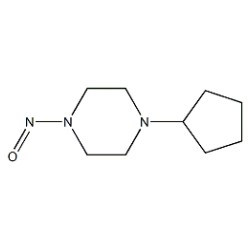
1-Cyclopentyl-4-nitrosopiperazine
ISO 17034 Reference Material
| Item number | 688614 |
| CAS | 61379-66-6 |
| Formula | C9H17N3O |
| Molecular weight | 183,25 g/mol |
| Quantity | 1x10mg |
| storage conditions | 4 °C |
| CoA / MSDS | Retrieve CoA Retrieve MSDS Show Safety Data Sheet online |
Price |
| Safety Data Sheet | according to Regulation (EC) No 1907/2006 (REACH) Classifications according to Regulation (EC) No 1272/2008. Printdate November 21, 2026 |
| IDENTIFICATION OF THE SUBSTANCE/MIXTURE AND OF THE COMPANY/UNDERTAKING | |
| Product name: | 1-Cyclopentyl-4-nitrosopiperazine |
| Catalog No.: | 688614 |
| Relevant identified uses of the substance or mixture | Identified: Laboratory chemical uses: R&D |
| Uses advised against: | HPC Standards Inc 271 17th Street, NW, Suite 1750 Atlanta, GA 30363 Tel. +1 (678) 244-1536 Fax. +1 (404) 586-6820 sales@hpc-standards.us |
| Emergency telephone number | HPC Standards Tel. +1 (678) 244-1536 This number is only available during office hours. |
| HAZARDS IDENTIFICATION | 2.1 Classification of the substance / mixture Classification according to Regulation (EC) No 1272/2008 Acute toxicity, oral(Category 4), H302 Acute toxicity, dermal(Category 4), H312 Acute toxicity, inhalation(Category 4), H332 Specific target organ toxicity, single exposure; Respiratory tract irritation(Category 3), H335 Skin corrosion/irritation(Category 1B), H314 Carcinogenicity(Category 1B), H350 |
| Label elements | |
| Pictogram | GHS05 acid acid GHS07 exclam exclam GHS08 silhouete silhouete |
| Labelling according to Regulation (EC) No 1272/2008 Pictogram: Signal word: Danger Hazard statement(s): H302 Harmful if swallowed H312 Harmful in contact with skin H332 Harmful if inhaled H335 May cause respiratory irritation H314 Causes severe skin burns and eye damage H350 May cause cancer Precautionary statements: P201 Obtain special instructions before use. P202 Do not handle until all safety precautions have been read and understood. P260 Do not breathe dust/fume/gas/mist/vapours/spray. P264 Wash hands thoroughly after handling. Wash skin thouroughly after handling. P270 Do not eat, drink or smoke when using this product. P271 Use only outdoors or in a well-ventilated area. P280 Wear protective gloves/protective clothing/eye protection/face protection. P301+P330+ P331 IF SWALLOWED: Rinse mouth. Do NOT induce vomiting. P302+P352 IF ON SKIN: wash with plenty of soap and water. P303+P361+ P353 IF ON SKIN (or hair): Remove/Take off Immediately all contaminated clothing. Rinse SKIN with water/shower. P304+P340 IF INHALED: Remove victim to fresh air and Keep at rest in a position comfortable for breathing. P305+P351+ P338 IF IN EYES: Rinse cautiously with water for several minutes. Remove contact lenses, if present and easy to do. Continue rinsing. P308+P313 IF exposed or concerned: Get medical advice/attention. P310 Immediately call a POISON CENTER or doctor/physician. P363 Wash contaminated clothing before reuse. P403+P233 Store in a well-ventilated place. Keep container tightly closed. P405 Store locked up. P501 Dispose of contents/container in accordance with local/regional/national/international regulations. Special note: Excessive pressure may build up in a container. Open container with caution to prevent container damage and accidental release. 2.3 Other hazards N/A | |
| COMPOSITION/INFORMATION ON INGREDIENTS | |
| Formula | C9H17N3O |
| Molecular Weight (g/mol) | 183.25 |
| CAS-No. | 61379-66-6 |
| FIRST AID MEASURES | 4.1 Description of first aid measures General advice: Consult a physician. Show this safety data sheet to the doctor in attendance. Inhalation: If inhaled, remove to fresh air. If not breathing give artificial respiration. If breathing is difficult, give oxygen. Seek medical attention immediately. Skin contact: In case of skin contact, flush with copious amounts of water for at least 15 minutes. Remove contaminated clothing and shoes. Call a physician. Eye contact: In case of contact with eyes, flush with copious amounts of water for at least 15 minutes. Assure adequate flushing by separating the eyelids with fingers. Call a physician. Ingestion: If swallowed, wash out mouth with water provided person is conscious. Call a physician. |
| FIRE-FIGHTING MEASURES | 5.1 Suitable extinguishing media Sand, carbon dioxide, dry chemical powder, or appropriate foam. 5.2 Specific hazards arising from the substance or mixture May emit toxic fumes under fire conditions including Carbon monoxide, Carbon dioxide, Nitrogen oxides. Danger of containers bursting upon heating. 5.3 Special protective equipment and precautions for firefighters Fire-extinguishing work is done from the windward and the suitable fire-extinguishing method according to the surrounding situation is used. Uninvolved persons should evacuate to a safe place. In case of fire in the surroundings: remove movable containers if safe to do so. Wear self-contained breathing apparatus and protective clothing to prevent contact with skin and eyes. |
| ACCIDENTAL RELEASE MEASURES | 6.1 Personal precautions, protective equipment and emergency procedures Use personal protective equipment. Avoid breathing vapours, mist or gas. Ensure adequate ventilation. For personal protection see section 8. 6.2 Environmental precautions Prevent further leakage or spillage if safe to do so. Do not let product enter drains. Discharge into the environment must be avoided. 6.3 Methods and materials for containment and cleaning up Wipe dry, place a rag in a bag and hold for waste disposal. Avoid fumes inhaling. Ventilate area and wash spill site after material pickup is complete. |
| HANDLING AND STORAGE | 7.1 Precautions for safe handling Handling is performed in a well ventilated place. Wear suitable protective equipment. Do not breathe vapor. Avoid contact with eyes, skin, and clothing. Avoid prolonged or repeated exposure. Wash hands and face thoroughly after handling. 7.2 Conditions for safe storage, including any incompatibilities Keep container tightly closed and upright. Avoid overheating. Store in a dry and well-ventilated place at +4°C. |
| EXPOSURE CONTROLS/PERSONAL PROTECTION | 8.1 Control parameters Components with workplace control parameters N/A 8.2 Appropriate engineering controls Install a closed system or local exhaust so that workers should not be exposed directly. Install safety shower and eye bath. Wash hands thoroughly after handling. 8.3 Personal protective equipment Respiratory Protection: Government approved respirator. Skin Protection: Compatible chemical-resistant gloves. Gloves must be inspected prior to use. Use proper glove removal technique (without touching glove’s outer surface) to avoid skin contact with this product. Wash and dry hands. Eye/Face Protection: Government approved eye/face protection equipment. Body protection: Protective clothing. Protective boots, if the situation requires. |
| PHYSICAL AND CHEMICAL PROPERTIES | Property Value At Temperature or Pressure Appearance (20°C) Physical state: liquid Odour: N/A Colour: yellow pH: N/A Melting point/freezing point (°C): N/A Initial boiling point and boiling point range (°C): N/A Flash Point (°C): N/A Vapour pressure: N/A Vapour density: N/A Relative density (g/ml): Partition coefficient: noctanol/water: 1.08 Auto-ignition temperature (°C): N/A Viscosity: N/A Flammability: N/A Explosive properties: N/A Oxidizing properties: N/A Water solubility: N/A Evaporation rate: N/A Refractive index: N/A |
| STABILITY AND REACTIVITY | 10.1 Chemical stability Stable under specified storage temperature. 10.2 Possibility of hazardous reactions No data available 10.3 Conditions to avoid No data available 10.4 Incompatible materials Strong oxidizing agents. 10.5 Hazardous decomposition products Carbon monoxide, Carbon dioxide, Nitrogen oxides |
| TOXICOLOGICAL INFORMATION | N/A Toxicological properties were not fully evaluated. |
| ECOLOGICAL INFORMATION | N/A |
| DISPOSAL CONSIDERATIONS | Substance disposal: Contact a licensed professional waste disposal service to dispose of this material. Dissolve or mix the material with a combustible solvent and burn in a chemical incinerator equipped with an afterburner and scrubber. Observe all federal, state, and local environmental regulations Contaminated packaging disposal: Dispose of as unused product |
| TRANSPORT INFORMATION | 14.1 UN number ADR/RID: 2922 IMDG: 2922 IATA: 2922 14.2 UN proper shipping name ADR/RID: CORROSIVE LIQUID, TOXIC, N.O.S. (1-cyclopentyl-4-nitrosopiperazine) IMDG: CORROSIVE LIQUID, TOXIC, N.O.S. (1-cyclopentyl-4-nitrosopiperazine) IATA: Corrosive liquid, toxic, n.o.s. (1-cyclopentyl-4-nitrosopiperazine) 14.3 Transport hazard class(es) ADR/RID: 8 (6.1) IMDG: 8 (6.1) IATA: 8 (6.1) 14.4 Packaging group ADR/RID: II IMDG: II IATA: II 14.5 Environmental hazards ADR/RID: no IMDG: no IATA: no 14.6 Special precautions for user No data available |
| REGULATORY INFORMATION | This safety datasheet complies with the requirements of Regulations (EC) No. 1907/2006 and No. 1272/2008. 15.1 Safety, health and environmental regulations specific for the substance or mixture No data available 15.2 Chemical Safety Assessment For this product no chemical safety assessment was carried out. |
| OTHER INFORMATION | The above information is believed to be correct but does not purport to be all inclusive and shall be used only as a guide. The information in this document is based on the present state of our knowledge and is applicable to the product with regard to appropriate safety precautions. It does not represent any guarantee of the properties of the product. For lab use only! |